


 |
July Constellations
June Constellations | Constellations Menu | August Constellations
The ten July constellations contain many well-known groups such as Draco, the dragon, Hercules, the strongman, and Scorpius, the scorpion. These groups are famous for their large number of globular star clusters. Scorpius is home to four Messier star clusters, as well as a bright, giant red star known as Antares. Ophiuchus contains an incredible number of Messier globular clusters, seven in all. Two additional globulars can be found in the constellation of Hercules. A small, lenticular galaxy can be seen lurking in the constellation of Draco and Serpens contains two Messier objects, a galaxy and a nebula. This is a beautiful diffuse nebula known as the Eagle Nebula. |
Apus | Ara | Corona Borealis | Draco | Hercules | Norma | Ophiuchus | Scorpius
Serpens | Triangulum Australe
|
| |
Apus |
The Bird of Paradise |
|
Pronunciation: (AY-pus)
Abbreviation: Aps Genitive: Apodis
Right Ascension: 16.16 hours Declination: -76.28 degrees
Area in Square Degrees: 206
Crosses Meridian: 9 PM, July 10
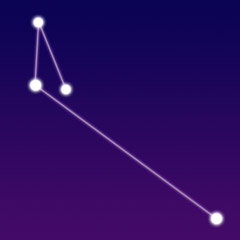
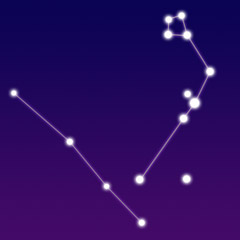
Apus, the Bird of Paradise, can be seen in all southern latitudes. In northern latitudes, it is only visible south of 7 degrees north. It is one of 12 constellations named by Johann Bayer to fill in the blanks in the southern sky. The constellation represents the bird of paradise also known at the time as Apus Indica, which means "Bird of India". The name may have also come from the Greek word Apous, which means "without feet". The beautiful Bird of India was often offered as a gift to the Europeans after its unsightly legs were removed. Apus is composed mainly of faint fourth and fifth magnitude stars, and contains no Messier objects. |
|
| Points of Interest in Apus |
 |
| None.
This constellation is composed mainly of 4th and 5th magnitude stars. |
|
|
Return to top of page  |
|
Pronunciation: (AY-ruh)
Abbreviation: Ara Genitive: Arae
Right Ascension: 17.39 hours Declination: -53.58 degrees
Area in Square Degrees: 237
Crosses Meridian: 9 PM, July 20
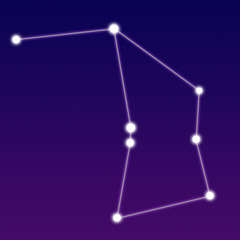
Ara, the Altar, is visible in southern latitudes from 22 degrees south and in northern latitudes to 43 degrees north from November through January. It is best observed during the month of July. This is an ancient constellation that has existed since the time of the Babylonians. It represents the altar of the centaur, Chiron, of Centaurus fame. Chiron was half man and half horse. He was considered to be the wisest creature on Earth. The altar was used by both the Greeks and Romans for offering sacrifices to the gods. Ara is located just south of the constellation Scorpius. Except for a few faint globular clusters, there is not much of interest to be found here. |
|
| Points of Interest in Ara |
 |
| None.
This constellation is composed mainly of 4th and 5th magnitude stars. |
|
|
Return to top of page  |
|
Pronunciation: (koh-ROH-nuh BOR-ee-AL-is)
Abbreviation: CrB Genitive: Coronae Borealis
Right Ascension: 15.89 hours Declination: 32.19 degrees
Area in Square Degrees: 179
Crosses Meridian: 9 PM, June 30
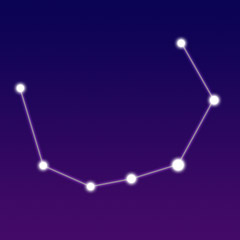
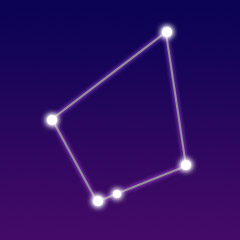
Corona Borealis, the Northern Crown, is visible in the northern hemisphere in the spring and summer. It represents the crown that Ariadne, the daughter of King Minos of Crete, wore at her wedding. Her ball of thread helped Theseus defeat the Minotaur, and he gave her the crown when they married. The crown was created by the supreme goldsmith, Hephaestus. Corona Borealis is a small constellation located between Hercules and Boötes. The brightest star is called Alphecca at magnitude 2.23. It shines like a jewel in the tip of the crown. There are no Messier objects and no notable items of interest in this constellation. |
|
| Points of Interest in Corona Borealis |
 |
Object |
Name |
Type/Translation |
V Mag |
| 1 |
Alphekka |
"Broken Ring" |
2.23 |
| 2 |
Nusakan |
"The Two Series" |
3.68 |
|
Return to top of page |
|
Pronunciation: (DRAY-koh)
Abbreviation: Dra Genitive: Draconis
Right Ascension: 17.75 hours Declination: 62.51 degrees
Area in Square Degrees: 1083
Crosses Meridian: 9 PM, July 20
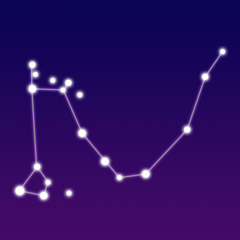
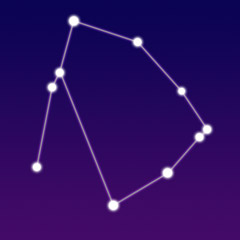
Draco, the Dragon, held special significance in the past. About 4000 years ago, it was the location of the pole star, as Ursa Minor is today. Due to the Earth's precession, the pole has now shifted to Polaris. Draco was the guardian of the star that never moves, the celestial pole. In ancient times, the pole star was believed to be the doorway between the mortal world and eternity. In Greek mythology, the dragon was Laden, a monstrous beast with a hundred heads chosen by Hera to guard to golden apples of immortality. These apples grew in the garden Hesperides, beyond the River of Time in the land of death. Laden was slain by Hercules in the eleventh of his twelve labors. Draco is located very close to the celestial pole, which makes it circumpolar. It is visible throughout the night. During the course of the year, it rotates upside down and back again. Draco contains one Messier object, M102, which is an edge-on galaxy with a dark dust lane. |
|
| Points of Interest in Draco |
 |
Object |
Name |
Type/Translation |
V Mag |
| 1 |
M102 |
Lenticular Galaxy |
9.9 |
| 2 |
Thuban |
"Snake" |
3.65 |
| 3 |
Rastaban |
"Head of the Snake" |
2.79 |
| 4 |
Etamin |
"Sea Monster" |
2.23 |
| 5 |
Nodus Secundus |
"Second Knot" |
3.07 |
| 6 |
Tyl |
* |
3.83 |
| 7 |
Aldhibah |
* |
3.17 |
| 8 |
Ed Asich |
"Hyena" |
3.29 |
| 9 |
Gianfar |
"Dragon" |
3.84 |
| 10 |
Arrakis |
"Dancer" |
5.80 |
| 11 |
Kuma |
"As Last" |
4.87 |
| 12 |
Grumium |
"Jaw" |
3.75 |
| 13 |
Alsafi |
"Cooking Tripods" |
4.68 |
| 14 |
Dsiban |
"The Two Jackals" |
4.58 |
|
Return to top of page |
|
Pronunciation: (HER-ku-leez)
Abbreviation: Her Genitive: Herculis
Right Ascension: 17.33 hours Declination: 29.90 degrees
Area in Square Degrees: 1225
Crosses Meridian: 9 PM, July 25
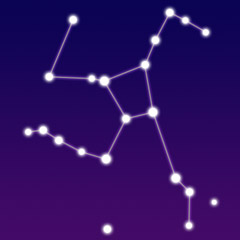
Hercules is best seen during the summer in the northern hemisphere. It the fifth largest constellation in the sky, but can be difficult to locate because of its dim stars. You can find it by looking between Draco and Ophiuchus. Hercules is visible in the southern hemisphere from May until August. The constellation was named after the son of Zeus, who defeated the Nemean Lion, Leo, and the many-headed beast called Hydra. While fighting Hydra, he also killed the little crab, Cancer. The Greeks called him Heracles, but to the Romans changed his name to Hercules. This constellation contains two Messier objects, both of which are globular star clusters, as well as a large number of binary stars. |
|
| Points of Interest in Hercules |
 |
Object |
Name |
Type/Translation |
V Mag |
| 1 |
M92 |
Globular Star Cluster |
6.4 |
| 2 |
M13 |
Globular Star Cluster |
5.8 |
| 3 |
Rasalgethi |
"Head of the Kneeling One" |
3.48 |
| 4 |
Kornephoros |
"Club-bearer" |
2.77 |
| 5 |
Sarin |
* |
3.14 |
| 6 |
Marfik |
"Wrist" |
5.00 |
| 7 |
Maasym |
* |
4.41 |
| 8 |
Kajam |
"Club" |
4.57 |
|
Return to top of page |
| |
Norma |
The Carpenter's Square |
|
Pronunciation: (NOR-muh)
Abbreviation: Nor Genitive: Normae
Right Ascension: 16.05 hours Declination: -52.01 degrees
Area in Square Degrees: 165
Crosses Meridian: 9 PM, July 5
Norma, the Carpenters Square, is completely visible in latitudes south of 30 degrees north from April through June. It represents to a carpenter's tool called a square, or a level. This is one of the 15 southern constellations named by Nicolas Louis de Lacaille in the mid-eighteenth century. He called it Norma et Regula, which meant "the Level and the Square". The name was later shortened to Norma. It can be found near the constellations Lupus and Scorpius, just north of Triangulum Australe and west of Ara. Norma is composed of faint stars and contains no objects of interest. |
|
| Points of Interest in Norma |
 |
| None.
This constellation is composed mainly of faint stars. |
|
|
Return to top of page |
|
Pronunciation: (OH-fee-U-kus)
Abbreviation: Oph Genitive: Ophiuchii
Right Ascension: 17.18 hours Declination: -4.24 degrees
Area in Square Degrees: 948
Crosses Meridian: 9 PM, July 25
Ophiuchus, the Serpent Bearer, is best seen in summer in the northern hemisphere and winter in the southern hemisphere. It is believed to be named after Aesculapius, a physician who was later made a god. Serpents were always associated with physicians, and this has given rise to the modern symbol for medicine. A little known fact about Ophiuchus is that it is one of the 13 constellations of the Zodiac. This means that the Sun passes through the constellation during the year. When the Babylonians invented the Zodiac about 300 years ago, it only contained 12 constellations. Because of the procession of the Earth's axis, the Sun now passes through Ophiuchus each year in December, making it a new member of the Zodiac by definition. Astronomers define the Zodiac as those constellations through which the Sun and planets travel. This path is known as the ecliptic. Ophiuchus contains the second closest star to Earth, known as Barnard's star. It is a red dwarf star located about 6 light-years away. At magnitude 9.5, it is not an easy star to find with the naked eye. Ophiuchus also contains seven Messier objects, all of which are globular star clusters. |
|
| Points of Interest in Ophiuchus |
 |
Object |
Name |
Type/Translation |
V Mag |
| 1 |
M14 |
Globular Star Cluster |
7.6 |
| 2 |
M10 |
Globular Star Cluster |
6.6 |
| 3 |
M12 |
Globular Star Cluster |
6.7 |
| 4 |
M9 |
Globular Star Cluster |
7.7 |
| 5 |
M107 |
Globular Star Cluster |
7.9 |
| 6 |
M19 |
Globular Star Cluster |
6.8 |
| 7 |
M62 |
Globular Star Cluster |
6.5 |
| 8 |
Rasalhague |
"Head of the Snake" |
2.08 |
| 9 |
Cebalrai |
"Dog of the Shepherd" |
2.77 |
| 10 |
Yed Prior |
"Western Hand" |
2.74 |
| 11 |
Yed Posterior |
"Eastern Hand" |
3.24 |
| 12 |
Sabik |
"The Preceding" |
2.43 |
| 13 |
Marfic |
"Elbow" |
3.82 |
|
Return to top of page |
|
Pronunciation: (SKOR-pee-us)
Abbreviation: Sco Genitive: Scorpii
Right Ascension: 16.99 hours Declination: -37.17 degrees
Area in Square Degrees: 497
Crosses Meridian: 9 PM, July 20
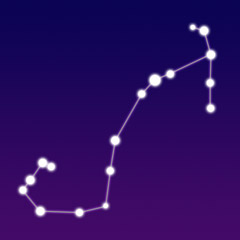
Scorpius, the Scorpion, can be seen in summer from the northern hemisphere, but is low in the sky and is best seen from the southern hemisphere or southern United States. It has a distinct "J" shape, also described as a fishhook. Scorpius represents the scorpion sent by a jealous Artemis to slay Orion. It was this scorpion's sting that caused Orion's death. The scorpion still chases Orion across the heavens, but will never catch him because it rises in the East after Orion has set in the West. This constellation is the location of the bright orange star known as Antares. Antares is a red supergiant star that is part of a binary system. At magnitude 0.96, it is the 15th brightest star in the sky. Scorpius also contains four Messier star clusters. |
|
| Points of Interest in Scorpius |
 |
Object |
Name |
Type/Translation |
V Mag |
| 1 |
M6 |
Open Star Cluster |
* |
| 2 |
M7 |
Open Star Cluster |
* |
| 3 |
M80 |
Globular Star Cluster |
* |
| 4 |
M4 |
Globular Star Cluster |
* |
| 5 |
Antares |
"Rival of Mars" |
0.96 |
| 6 |
Graffias |
"Crab" |
2.62 |
| 7 |
Dschubba |
"Forehead" |
2.32 |
| 8 |
Sargas |
* |
1.87 |
| 9 |
Shaula |
"Raised Tail" |
1.63 |
| 10 |
Jabbah |
"Forehead" |
4.01 |
| 11 |
Alniyat |
"Shield of the Heart" |
2.89 |
| 12 |
Lesath |
"Stinger" |
2.69 |
|
Return to top of page |
|
Pronunciation: (SER-penz)
Abbreviation: Ser Genitive: Serpentis
Right Ascension: 15.71 hours Declination: 9.07 degrees
Area in Square Degrees: 637 (Serpens Caput: 429, Serpens Cauda: 208)
Crosses Meridian: Serpens Caput: 9 PM, June 30; Serpens Cauda, 9 PM, August 5
Serpens, the Serpent, is best seen in the summer from the northern hemisphere. Although this is officially one constellation, it is actually split into two distinct, disjoint areas of the sky. It is divided by the constellation Ophiuchus, the Serpent Bearer, who holds the serpent in his hands. These two areas are known as Serpens Caput (the head of the serpent) and Serpens Cauda (the tail of the serpent). This is the only constellation that is split in this fashion. Serpens contains two messier objects. M16 is a diffuse nebula also known as the Eagle Nebula, so named because it resembles an eagle in flight. The other object, M5, is a globular star cluster. |
|
| Points of Interest in Serpens |
 |
Object |
Name |
Type/Translation |
V Mag |
| 1 |
M16 |
Diffuse Nebula |
* |
| 2 |
M5 |
Globular Star Cluster |
* |
| 3 |
Unukalhai |
"Neck of the Snake" |
2.65 |
| 4 |
Alya |
"Snake" |
4.62 |
|
Return to top of page |
|
Pronunciation: (try-ANG-gu-lum ahs-TRAY-lee)
Abbreviation: TrA Genitive: Trianguli Australis
Right Ascension: 16.08 hours Declination: -65.92 degrees
Area in Square Degrees: 110
Crosses Meridian: 9 PM, July 5
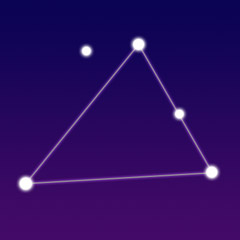
Triangulum Australe, the Southern Triangle, is completely visible in latitudes south of 20 degrees north from April through June. Its three brightest stars have been called the "Three Patriarchs", Abraham, Isaac and Jacob. It can easily be recognized by its shape, or asterism. This is one of the 12 southern constellations named by Johann Bayer in the early 1600's. The three bright stars in this constellation are so recognizable that they can be used to locate others around it such as Apus in the south, Norma in the north, Circinus and Centaurus in the west, Ara and Pavo to the east. Triangulum Australe contains Messier objects. |
|
| Points of Interest in Triangulum Australe |
 |
| None.
This constellation is composed mainly of faint stars. |
|
|
Return to top of page |
June Constellations | Constellations Menu | August Constellations
|
|
 |
|