


|
|
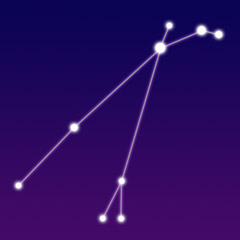
Pronunciation: (EH-reez)
Abbreviation: Ari Genitive: Arietis
Right Ascension: 2.66 hours Declination: 20.09 degrees
Area in Square Degrees: 441
Crosses Meridian: 9 PM, December 10
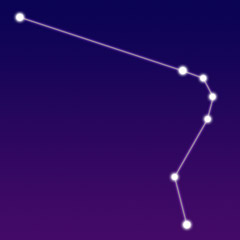
Aries can be seen in the northern hemisphere during the late winter and early spring. It is a small constellation bounded by Taurus, Pisces, and Cetus. Aries is an ancient constellation, which was known as the Ram to the Babylonians, the Egyptians, the Greeks and the Persians. In Greek mythology, it represents the ram from which the golden fleece was obtained in the story of Jason and the Argonauts. |
|
| Points of Interest in Aries |
 |
Object |
Name |
Type/Translation |
V Mag |
| 1 |
Hamal |
"Ram" |
2.00 |
| 2 |
Sharatan |
"The Two Signs" |
2.64 |
| 3 |
Mesarthim |
"The Fat Ram" |
4.75 |
| 4 |
Botein |
"Little Belly" |
4.35 |
|
Return to top of page  |
|
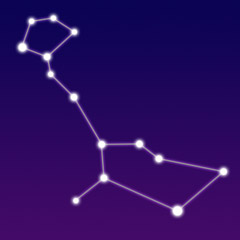
Pronunciation: (SEE-tus)
Abbreviation: Cet Genitive: Ceti
Right Ascension: 1.42 hours Declination: -11.35 degrees
Area in Square Degrees: 1231
Crosses Meridian: 9 PM, November 30
Cetus is a large constellation, occupying 50 degrees in length and 20 degrees in width. As large as it is, it contains no stars brighter than 2nd magnitude. It represents the sea monster sent by Neptune to devour Andromeda. Cetus was turned to stone when Perseus showed the monster the head of Medusa. Cetus has also been identified as the Biblically famous whale that swallowed Jonah. |
|
| Points of Interest in Cetus |
 |
Object |
Name |
Type/Translation |
V Mag |
| 1 |
M77 |
Spiral Galaxy |
8.9 |
| 2 |
Menkar |
"Nose" |
2.53 |
| 3 |
Diphda |
"Tail of Cetus" |
2.04 |
| 4 |
Kaffaljidhma |
"Cut-short Hand" |
3.47 |
| 5 |
Baten Kaitos |
"Belly of Cetus" |
3.73 |
| 6 |
Dheneb |
* |
3.45 |
| 7 |
Deneb Kaitos Shemali |
* |
3.56 |
| 8 |
Mira |
"Wonderful" |
3.04 |
|
Return to top of page  |
|
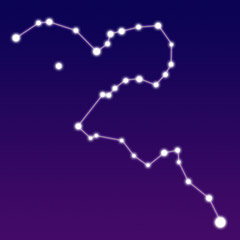
Pronunciation: (eh-RID-uh-nus)
Abbreviation: Eri Genitive: Eridani
Right Ascension: 3.92 hours Declination: -15.82 degrees
Area in Square Degrees: 1138
Crosses Meridian: 9 PM, January 5
Eridanus is visible from latitudes south of 32 degrees north. Portions of the constellation are visible worldwide, from October through December. It is represented as a long, winding river that starts at the left foot of Orion in the north, sweeps south of Taurus, west to the edge of Cetus, back east to Caelum. It eventually ends to the south, at the border with Hydrus. It is not known which river the constellation is named after, but it may have been a mythical river. |
|
| Points of Interest in Eridanus |
 |
Object |
Name |
Type/Translation |
V Mag |
| 1 |
Achernar |
"End of the River" |
0.46 |
| 2 |
Cursa |
"Footstool of Orion" |
2.79 |
| 3 |
Zaurak |
"Boat" |
2.95 |
| 4 |
Rana |
"Frog" |
3.54 |
| 5 |
Azha |
"Hatching Place" |
.89 |
| 6 |
Acamar |
"End of the River" |
3.24 |
| 7 |
Beid |
"Ostrich Eggs" |
4.04 |
| 8 |
Keid |
"Broken Eggshell" |
4.43 |
| 9 |
Angetenar |
"Curve of the River" |
4.75 |
| 10 |
Theemim |
* |
3.82 |
| 11 |
Sceptrum |
* |
3.87 |
|
Return to top of page |
|
Pronunciation: (FOR-naks)
Abbreviation: For Genitive: Fornacis
Right Ascension: 2.78 hours Declination: -31.63 degrees
Area in Square Degrees: 398
Crosses Meridian: 9 PM, December 15
Fornax is visible from latitudes south of 50 degrees north from October through December. It is one of 15 constellations named by Abbé Nicolas Louis de Lacaille and represents a chemical furnace in honor of Antoine Lavoisier, who was guillotined in the French Revolution in 1794. |
|
| Points of Interest in Fornax |
 |
Object |
Name |
Type/Translation |
V Mag |
| 1 |
Fornacis |
* |
3.87 |
|
Return to top of page |
|
Pronunciation: (HOR-oh-LOH-jee-um)
Abbreviation: Hor Genitive: Horologii
Right Ascension: 3.11 hours Declination: -52.8 degrees
Area in Square Degrees: 249
Crosses Meridian: 9 PM, December 25
Horologium is visible from latitudes south of 23 degrees north, from October through December. It was named by Lacaille, and was originally called Horologium Oscillitorium to honor Christian Huygens, the inventor of the pendulum clock in 1656-57. |
|
| Points of Interest in Horologium |
 |
| None.
This constellation is composed mainly of faint stars. |
|
|
Return to top of page |
| |
Hydrus |
The Southern Water Snake |
|
Pronunciation: (HYD-russ)
Abbreviation: Hyi Genitive: Hydri
Right Ascension: 2.46 hours Declination: -72.28 degrees
Area in Square Degrees: 243
Crosses Meridian: 9 PM, December 10
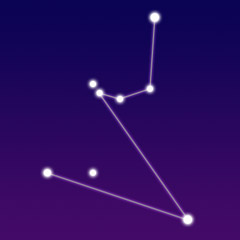
The constellation Hydrus can be seen in latitudes south of 8 degrees north from September through November. It is one of 12 constellations named by Johann Bayer. It is often confused with Hydra, the large constellation further north. |
|
| Points of Interest in Hydrus |
 |
Object |
Name |
Type/Translation |
V Mag |
| 1 |
Head of Hydrus |
* |
2.86 |
|
Return to top of page |
|
Pronunciation: (PER-see-us)
Abbreviation: Per Genitive: Persei
Right Ascension: 3.71 hours Declination: 41.77 degrees
Area in Square Degrees: 615
Crosses Meridian: 9 PM, December 25
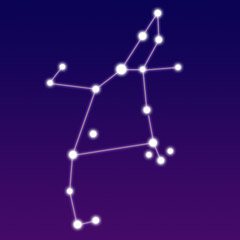
Perseus can be seen in late summer and autumn in the northern hemisphere. It was named after the legendary hero who rescued Andromeda from the monster, Cetus, by bringing back the head of Medusa to turn it into stone. Perseus and Andromeda fell in love and were both placed among the stars. |
|
| Points of Interest in Perseus |
 |
Object |
Name |
Type/Translation |
V Mag |
| 1 |
M76 |
Planetary Nebula |
10.1 |
| 2 |
M34 |
Open Star Cluster |
5.5 |
| 3 |
Mirphak |
"Elbow" |
1.79 |
| 4 |
Algol |
"The Ghoul" |
2.12 |
| 5 |
Miram |
* |
3.76 |
| 6 |
Menkib |
"Shoulder" |
4.04 |
| 7 |
Atik |
"Shoulder" |
3.83 |
| 8 |
Gorgonea Secunda |
* |
4.70 |
| 9 |
Gorgonea Tertia |
* |
3.39 |
| 10 |
Gorgonea Quata |
* |
3.39 |
|
Return to top of page |
|
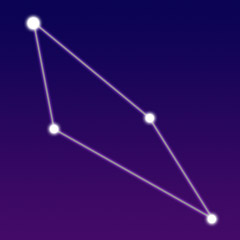
Pronunciation: (try-ANG-gu-lum)
Abbreviation: Tri Genitive: Trianguli
Right Ascension: 2.11 hours Declination: 32.03 degrees
Area in Square Degrees: 132
Crosses Meridian: 9 PM, December 5
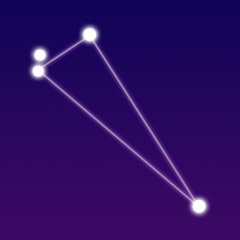
Triangulum is completely visible in latitudes north of 53 degrees south from March through May. It is one of the original 48 constellations first drawn by Ptolemy. In ancient times, its distinctive shape of three stars was called Deltoton. |
|
| Points of Interest in Triangulum |
 |
Object |
Name |
Type/Translation |
V Mag |
| 1 |
M33 |
Spiral Galaxy |
5.7 |
| 2 |
Metallah |
"Head of the Triangle" |
3.41 |
|
Return to top of page |