


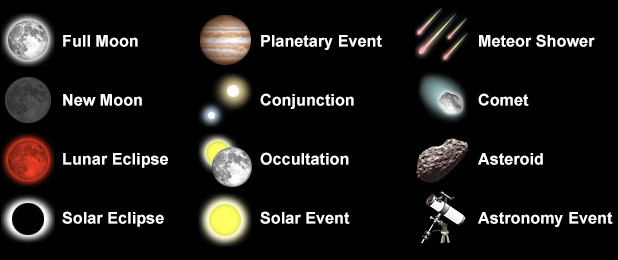
This astronomy calendar of celestial events contains dates for notable celestial events including moon phases, meteor showers, eclipses, oppositions, conjunctions, and other interesting events. Most of the astronomical events on this calendar can be seen with unaided eye, although some may require a good pair of binoculars for best viewing. Many of the events and dates that appear here were obtained from the U.S. Naval Observatory, The Old Farmer's Almanac., and the American Meteor Society. Events on the calendar are organized by date and each is identified with an astronomy icon as outlined below. Please note that all dates and times are given in Coordinated Universal Time (UTC) must be converted to your local date and time. You can use the UTC clock widget below to figure out how many hours to add or subtract for your local time.
January 3, 4 - Quadrantids Meteor Shower. The Quadrantids is an above average shower, with up to 40 meteors per hour at its peak. It is thought to be produced by dust grains left behind by an extinct comet known as 2003 EH1, which was discovered in 2003. The shower runs annually from January 1-5. It peaks this year on the night of the 3rd and morning of the 4th. This should be an excellent year for the Quadrantids because there will be no moonlight to spoil the show. Best viewing will be from a dark location after midnight. Meteors will radiate from the constellation Bootes, but can appear anywhere in the sky.
January 4 - New Moon. The Moon is directly between the Earth and the Sun and is not visible. This phase occurs at 09:03 UTC. This is the best time of the month to observe faint objects such as galaxies and star clusters because there is no moonlight to interfere.
January 4 - Partial Solar Eclipse. A partial solar eclipse occurs when the Moon covers only a part of the Moon, sometimes resembling a bite taken out of a cookie. A partial solar eclipse can only be safely observed with a special solar filter or by looking at the Sun's reflection. The partial eclipse will be visible in most parts of northern Africa, Europe, and Asia. (NASA Map and Eclipse Information)
January 19 - Full Moon. The Moon will be directly opposite the Earth from the Sun and will be fully illuminated as seen from Earth. This phase occurs at 21:21 UTC. This full moon was known by early Native American tribes as the Full Wolf Moon because this was the time of year when hungry wolf packs howled outside their camps. This moon has also been know as the Old Moon and the Moon After Yule.
February 3 - New Moon. The Moon will be directly between the Earth and the Sun and will not be visible from Earth. This phase occurs at 02:31 UTC. This is the best time of the month to observe faint objects such as galaxies and star clusters because there is no moonlight to interfere.
February 18 - Full Moon. The Moon will be directly opposite the Earth from the Sun and will be fully illuminated as seen from Earth. This phase occurs at 08:36 UTC. This full moon was known by early Native American tribes as the Full Snow Moon because the heaviest snows usually fell during this time of the year. Since hunting is difficult, this moon has also been known by some tribes as the Full Hunger Moon.
March 4 - New Moon. The Moon will be directly between the Earth and the Sun and will not be visible from Earth. This phase occurs at 20:46 UTC. This is the best time of the month to observe faint objects such as galaxies and star clusters because there is no moonlight to interfere.
March 19 - Full Moon. The Moon will be directly opposite the Earth from the Sun and will be fully illuminated as seen from Earth. This phase occurs at 18:10 UTC. This full moon was known by early Native American tribes as the Full Worm Moon because this was the time of year when the ground would begin to soften and the earthworms would reappear. This moon has also been known as the Full Crow Moon, the Full Crust Moon, and the Full Sap Moon. This will also be the largest full moon of the year because it will be near perigee, its closest point to the Earth. It is also the largest and closest full moon in the last 18 years. Astronomers call this a supermoon, a phenomenon that occurs about every 18 years,
March 20 - March Equinox. The March Equinox occurs at 23:21 UTC. The Sun will shine directly on the equator and there will be nearly equal amounts of day and night throughout the world. This is also the first day of spring (vernal equinox) in the Northern Hemisphere and the first day of fall (autumnal equinox) in the Southern Hemisphere.
April 3 - New Moon. The Moon will be directly between the Earth and the Sun and will not be visible from Earth. This phase occurs at 14:32 UTC. This is the best time of the month to observe faint objects such as galaxies and star clusters because there is no moonlight to interfere.
April 3 - Saturn at Opposition. The ringed planet will be at its closest approach to Earth and its face will be fully illuminated by the Sun. This is the best time to view and photograph Saturn and its moons. A medium-sized or larger telescope will allow you to see Saturn's rings and a few of its brightest moons.
April 18 - Full Moon. The Moon will be directly opposite the Earth from the Sun and will be fully illuminated as seen from Earth. This phase occurs at 02:44 UTC. This full moon was known by early Native American tribes as the Full Pink Moon because it marked the appearance of the moss pink, or wild ground phlox, which is one of the first spring flowers. This moon has also been known as the Sprouting Grass Moon and the Growing Moon.
April 22, 23 - Lyrids Meteor Shower. The Lyrids is an average shower, usually producing about 20 meteors per hour at its peak. It is produced by dust particles left behind by comet C/1861 G1 Thatcher, which was discovered in 1861. The shower runs annually from April 16-25. It peaks this year on the night of the night of the 22nd and morning of the 23rd. These meteors can sometimes produce bright dust trails that last for several seconds. The second quarter moon may be a slight problem this year, blocking out all but the brightest meteors. Best viewing will be from a dark location after midnight. Meteors will radiate from the constellation Lyra, but can appear anywhere in the sky.
May 3 - New Moon. The Moon will be directly between the Earth and the Sun and will not be visible from Earth. This phase occurs at 06:51 UTC. This is the best time of the month to observe faint objects such as galaxies and star clusters because there is no moonlight to interfere.
May 5, 6 - Eta Aquarids Meteor Shower. The Eta Aquarids is an above average shower, capable of producing up to 60 meteors per hour at its peak. Most of the activity is seen in the Southern Hemisphere. In the Northern Hemisphere, the rate can reach about 30 meteors per hour. It is produced by dust particles left behind by comet Halley, which has been observed since ancient times. The shower runs annually from April 19 to May 28. It peaks this year on the night of May 5 and the morning of the May 6. The thin crescent moon will set early in the evening leaving dark skies for what should be a good show. Best viewing will be from a dark location after midnight. Meteors will radiate from the constellation Aquarius, but can appear anywhere in the sky.
May 7 - Astronomy Day Part 1. Astronomy Day is an annual event intended to provide a means of interaction between the general public and various astronomy enthusiasts, groups and professionals. The theme of Astronomy Day is "Bringing Astronomy to the People," and on this day astronomy and stargazing clubs and other organizations around the world will plan special events. You can find out about special local events by contacting your local astronomy club or planetarium. You can also find more about Astronomy Day by checking the Web site for the Astronomical League.
May 11 - Conjunction of Mercury, Venus, and Jupiter. Conjunctions are rare events where two or more objects will appear extremely close together in the night sky. The three planets will form a 2-degree long vertical line in the early morning sky. The planet Mars will also be visible nearby. Look to the east near sunrise.
May 17 - Full Moon. The Moon will be directly opposite the Earth from the Sun and will be fully illuminated as seen from Earth. This phase occurs at 11:09 UTC. This full moon was known by early Native American tribes as the Full Flower Moon because this was the time of year when spring flowers appeared in abundance. This moon has also been known as the Full Corn Planting Moon and the Milk Moon.
June 1 - New Moon. The Moon will be directly between the Earth and the Sun and will not be visible from Earth. This phase occurs at 21:03 UTC. This is the best time of the month to observe faint objects such as galaxies and star clusters because there is no moonlight to interfere.
June 1 - Partial Solar Eclipse. A partial solar eclipse occurs when the Moon covers only a part of the Moon, sometimes resembling a bite taken out of a cookie. A partial solar eclipse can only be safely observed with a special solar filter or by looking at the Sun's reflection. The partial eclipse will be visible in most parts eastern Asia, Alaska, northern Canada, and Greenland. (NASA Map and Eclipse Information)
June 15 - Full Moon. The Moon will be directly opposite the Earth from the Sun and will be fully illuminated as seen from Earth. This phase occurs at 21:13 UTC. This full moon was known by early Native American tribes as the Full Strawberry Moon because it signaled the time of year to gather ripening fruit. It also coincides with the peak of the strawberry harvesting season. This moon has also been known as the Full Rose Moon and the Full Honey Moon.
June 15 - Total Lunar Eclipse. A total lunar eclipse occurs when the Moon passes completely through the Earth's dark shadow, or umbra. During this type of eclipse, the Moon will gradually get darker and then take on a blood red color. The eclipse will be visible throughout most of South America, Europe, Africa, Asia, and Australia. (NASA Map and Eclipse Information)
June 21 - June Solstice. The June solstice occurs at 17:16 UTC. The North Pole of the earth will be tilted toward the Sun, which will have reached its northernmost position in the sky and will be directly over the Tropic of Cancer at 23.44 degrees north latitude. This is the first day of summer (summer solstice) in the Northern Hemisphere and the first day of winter (winter solstice) in the Southern Hemisphere.
July 1 - New Moon. The Moon will be directly between the Earth and the Sun and will not be visible from Earth. This phase occurs at 08:54 UTC. This is the best time of the month to observe faint objects such as galaxies and star clusters because there is no moonlight to interfere.
July 1 - Partial Solar Eclipse. A partial solar eclipse occurs when the Moon covers only a part of the Moon, sometimes resembling a bite taken out of a cookie. A partial solar eclipse can only be safely observed with a special solar filter or by looking at the Sun's reflection. This partial eclipse will only be visible off the coast of Antarctica. (NASA Map and Eclipse Information)
July 15 - Full Moon. The Moon will be directly opposite the Earth from the Sun and will be fully illuminated as seen from Earth. This phase occurs at 06:40 UTC. This full moon was known by early Native American tribes as the Full Buck Moon because the male buck deer would begin to grow their new antlers at this time of year. This moon has also been known as the Full Thunder Moon and the Full Hay Moon.
July 28, 29 - Delta Aquarids Meteor Shower. The Delta Aquarids is an average shower that can produce up to 20 meteors per hour at its peak. It is produced by debris left behind by comets Marsden and Kracht. The shower runs annually from July 12 to August 23. It peaks this year on the night of July 28 and morning of July 29. This should be a great year for this shower because there will be almost no moonlight to spoil the show. Best viewing will be from a dark location after midnight. Meteors will radiate from the constellation Aquarius, but can appear anywhere in the sky.
July 30 - New Moon. The Moon will be directly between the Earth and the Sun and will not be visible from Earth. This phase occurs at 18:40 UTC. This is the best time of the month to observe faint objects such as galaxies and star clusters because there is no moonlight to interfere.
August 12, 13 - Perseids Meteor Shower. The Perseids is one of the best meteor showers to observe, producing up to 60 meteors per hour at its peak. It is produced by comet Swift-Tuttle, which was discovered in 1862. The Perseids are famous for producing a large number of bright meteors. The shower runs annually from July 17 to August 24. It peaks this year on the night of August 12 and the morning of August 13. The full moon will block out some of the meteors this year, but the Perseids are so bright and numerous that it should still be a good show. Best viewing will be from a dark location after midnight. Meteors will radiate from the constellation Perseus, but can appear anywhere in the sky.
August 13 - Full Moon. The Moon will be directly opposite the Earth from the Sun and will be fully illuminated as seen from Earth. This phase occurs at 18:57 UTC. This full moon was known by early Native American tribes as the Full Sturgeon Moon because the large sturgeon fish of the Great Lakes and other major lakes were more easily caught at this time of year. This moon has also been known as the Green Corn Moon and the Grain Moon.
August 11 - Neptune at Opposition. The blue giant planet will be at its closest approach to Earth and its face will be fully illuminated by the Sun. This is the best time to view and photograph Neptune. Due to its extreme distance from Earth, it will only appear as a tiny blue dot in all but the most powerful telescopes.
August 29 - New Moon. The Moon will be directly between the Earth and the Sun and will not be visible from Earth. This phase occurs at 03:04 UTC. This is the best time of the month to observe faint objects such as galaxies and star clusters because there is no moonlight to interfere.
September 12 - Full Moon. The Moon will be directly opposite the Earth from the Sun and will be fully illuminated as seen from Earth. This phase occurs at 09:27 UTC. This full moon was known by early Native American tribes as the Full Corn Moon because the corn is harvested around this time of year. This moon is also known as the Harvest Moon. The Harvest Moon is the full moon that occurs closest to the September equinox each year.
September 23 - September Equinox. The September equinox occurs at 09:05 UTC. The Sun will shine directly on the equator and there will be nearly equal amounts of day and night throughout the world. This is also the first day of fall (autumnal equinox) in the Northern Hemisphere and the first day of spring (vernal equinox) in the Southern Hemisphere.
September 25 - Uranus at Opposition. The blue-green planet will be at its closest approach to Earth and its face will be fully illuminated by the Sun. This is the best time to view Uranus. Due to its distance, it will only appear as a tiny blue-green dot in all but the most powerful telescopes.
September 27 - New Moon. The Moon will be directly between the Earth and the Sun and will not be visible from Earth. This phase occurs at 11:09 UTC. This is the best time of the month to observe faint objects such as galaxies and star clusters because there is no moonlight to interfere.
October 1 - Astronomy Day Part 2. Astronomy Day is an annual event intended to provide a means of interaction between the general public and various astronomy enthusiasts, groups and professionals. The theme of Astronomy Day is "Bringing Astronomy to the People," and on this day astronomy and stargazing clubs and other organizations around the world will plan special events. You can find out about special local events by contacting your local astronomy club or planetarium. You can also find more about Astronomy Day by checking the Web site for the Astronomical League.
October 12 - Full Moon. The Moon will be directly opposite the Earth from the Sun and will be fully illuminated as seen from Earth. This phase occurs at 02:06 UTC. This full moon was known by early Native American tribes as the Full Hunters Moon because at this time of year the leaves are falling and the game is fat and ready to hunt. This moon has also been known as the Travel Moon and the Blood Moon. This will also be the smallest full moon of the year because it will be near apogee, its farthest point from the Earth.
October 16 - Comet Elinin. Newly discovered comet Elinin will make its closest approach to the Earth on October 16. The comet was discovered on December 10, 2010 by Russian amateur astronomer Leonid Elenin. It is estimated that the comet will reach 6th magnitude as it makes its closest approach. This will make it just barely visible to the naked eye. With a good pair of binoculars and a little determination, you may be able to get a good look at this new comet during mid October.
October 21, 22 - Orionids Meteor Shower. The Orionids is an average shower producing up to 20 meteors per hour at its peak. It is produced by dust grains left behind by comet Halley, which has been known and observed since ancient times. The shower runs annually from October 2 to November 7. It peaks this year on the night of October 21 and the morning of October 22. The waning crescent moon will not be much of a problem this year. The Orionids tend to be fairly bright so it should be a good show. Best viewing will be from a dark location after midnight. Meteors will radiate from the constellation Orion, but can appear anywhere in the sky.
October 26 - New Moon. The Moon will be directly between the Earth and the Sun and will not be visible from Earth. This phase occurs at 19:56 UTC. This is the best time of the month to observe faint objects such as galaxies and star clusters because there is no moonlight to interfere.
October 29 - Jupiter at Opposition. The giant planet will be at its closest approach to Earth and its face will be fully illuminated by the Sun. This is the best time to view and photograph Jupiter and its moons. The giant planet will be a big and bright as it gets in the night sky. A medium-sized telescope should be able to show you some of the details in Jupiter's cloud bands. A good pair of binoculars should allow you to see Jupiter's four largest moons, appearing as bright dots on either side of the planet.
November 8 - Asteroid 2005 YU55 Flyby. An asteroid known as 2005 YU55 will make a close approach to the Earth. The large space rock, about 1,300 feet in diameter will pass closer than the Moon at 0.85 lunar distances. While it is not expected to pose a threat to the Earth, this extremely rare event presents a unique opportunity for amateur astronomers to observe the asteroid as it makes it closest approach to our planet. Many astronomy groups are planning to observe the event. Asteroids this large only pass close to the Earth about every 30 years.
November 10 - Full Moon. The Moon will be directly opposite the Earth from the Sun and will be fully illuminated as seen from Earth. This phase occurs at 20:16 UTC. This full moon was known by early Native American tribes as the Full Beaver Moon because this was the time of year to set the beaver traps before the swamps and rivers froze. It has also been known as the Frosty Moon and the Hunter's Moon.
November 17, 18 - Leonids Meteor Shower. The Leonids is an average shower, producing up to 15 meteors per hour at its peak. This shower is unique in that it has a cyclonic peak about every 33 years where hundreds of meteors per hour can be seen. That last of these occurred in 2001. The Leonids is produced by dust grains left behind by comet Tempel-Tuttle, which was discovered in 1865. The shower runs annually from November 6-30. It peaks this year on the night of the 17th and morning of the 18th. The second quarter moon will block some of the dim meteors this year, but if you are patient you should be able to catch quite a few good ones. Best viewing will be from a dark location after midnight. Meteors will radiate from the constellation Leo, but can appear anywhere in the sky.
November 25 - New Moon. The Moon will be directly between the Earth and the Sun and will not be visible from Earth. This phase occurs at 06:10 UTC. This is the best time of the month to observe faint objects such as galaxies and star clusters because there is no moonlight to interfere.
November 25 - Partial Solar Eclipse. This partial eclipse will only be visible over Antarctica and parts of South Africa and Tasmania. (NASA Map and Eclipse Information)
December 10 - Full Moon. The Moon will be directly opposite the Earth from the Sun and will be fully illuminated as seen from Earth. This phase occurs at 14:36 UTC. This full moon was known by early Native American tribes as the Full Cold Moon because this is the time of year when the cold winter air settles in and the nights become long and dark. This moon has also been known as the Moon Before Yule and the Full Long Nights Moon.
December 10 - Total Lunar Eclipse. A total lunar eclipse occurs when the Moon passes completely through the Earth's dark shadow, or umbra. During this type of eclipse, the Moon will gradually get darker and then take on a rusty or blood red color. The eclipse will be visible throughout most of Europe, eastern Africa, Asia, Australia, the Pacific Ocean, and the North America. (NASA Map and Eclipse Information)
December 13, 14 - Geminids Meteor Shower. The Geminids is the king of the meteor showers. It is considered by many to be the best shower in the heavens, producing up to 120 multicolored meteors per hour at its peak. It is produced by debris left behind by an asteroid known as 3200 Phaethon, which was discovered in 1982. The shower runs annually from December 7-17. It peaks this year on the night of the 13th and morning of the 14th. The waning gibbous moon will block out some of the meteors this year, but the Geminids are so bright and numerous that it should still be a good show. Best viewing will be from a dark location after midnight. Meteors will radiate from the constellation Gemini, but can appear anywhere in the sky.
December 22 - December Solstice. The December solstice occurs 05:30 UTC. The South Pole of the earth will be tilted toward the Sun, which will have reached its southernmost position in the sky and will be directly over the Tropic of Capricorn at 23.44 degrees south latitude. This is the first day of winter (winter solstice) in the Northern Hemisphere and the first day of summer (summer solstice) in the Southern Hemisphere.
December 24 - New Moon. The Moon will be directly between the Earth and the Sun and will not be visible from Earth. This phase occurs at 18:06 UTC. This is the best time of the month to observe faint objects such as galaxies and star clusters because there is no moonlight to interfere.
Glossary of Terms | Astronomy FAQ | Messier Catalog | Astronomical Calendar
Events & Star Parties | Clubs & Organizations | Equipment Guide | Astronomy Software
Astrophoto Gallery | Astronomy Suppliers | Astronomy Resources | My Sky